Annual Pay Remit Guidance and Approval Process
With the Executive’s endorsement, the Finance Minister is responsible for monitoring, controlling and approving annual Pay Remits* for all staff groups whose expenditure scores against the Northern Ireland Departmental Expenditure Limit (DEL) within the broad parameters of public sector pay.
In practice, in line with the principle of cascading delegations, however, Departments and Arm’s length Bodies (ALBs) have delegated responsibility for approval of annual Pay Remits pertaining to their staff groups that meet certain conditions without recourse to DoF for approval. Further information on these conditions can be found in the Approvals section of the annual Pay Remit guidance webpage linked below.
*An annual Pay Remit is the vehicle to seek and obtain the appropriate approval to make an offer of a pay award through setting out the detail and impact of such an award within a consistent framework.
Purpose
The webpage provides guidance on the completion of annual Pay Remits and covers the approval process in relation to pay arrangements for most public sector workers in Northern Ireland. The guidance must be applied in line with the relevant Finance Director (FD) letter(s) for the year(s) under consideration. The purpose of the FD letter is to set out the approach to public sector pay for a particular year. The guidance and process provided on the webpage consolidates guidance and processes from previous FD letters into a single place for those completing annual Pay Remits, avoiding the need to consult previous years’ FD letters in most cases. The webpage will be updated periodically in line with developments in the approach to public sector pay, approval processes and guidance.
Principles
The guidance exists to provide a mechanism to reward staff appropriately in line with workforce needs whilst helping ensure expenditure control in line with the wider principles contained in Managing Public Money NI (MPMNI) relating to accountability, proprietary, regularity and value for money in the use of public expenditure. Effective management of public sector pay and workforce issues is crucial to the delivery of high-quality public services, the achievement of departmental objectives and targets, and the management of the overall budgetary position.
Who does this guidance apply to?
All public bodies whose expenditure scores against the NI DEL are required to complete an annual Pay Remit and submit this to the appropriate approval authority. This includes all NICS departments (including non-ministerial departments), agencies, Non-Departmental Public Bodies (NDPBs) and other relevant ALBs.
Staff groups currently not covered by the annual Pay Remit process include: staff employed by Public Corporations, Higher Education, District Councils, North/South Bodies and Ministerial appointments (however, contractual conditions of all new Ministerial appointments should still include adherence to the principles of public sector pay).
It should be noted that the annual Pay Remit process for civil servants in NICS departments is separately applied by NICS HR, which takes account of public sector pay parameters when determining the NICS pay award. ALBs that choose to follow NICS terms and conditions, but whose staff are public servants, not civil servants, must wait for the NICS determination.
Approach to Public Sector Pay
Dear Finance Director (FD) letters on Public Sector Pay and Pay Remit Approvals can be found at the following link:
These must be fully adhered to in annual Pay Remits brought forward for approval in relation to the year in which they apply (e.g., annual Pay Remits for the 2025-26 year must follow the approach set out in the FD letter for 2025-26).
It is important to remember that public sector pay consumes a very significant proportion of the Executive’s budget and the overarching approach has three principles:
i. Pay awards must be affordable within each department’s budget settlement. This is to ensure essential public services and public sector employment can be sustainably funded and to avoid creating potentially unaffordable recurrent budget pressures going forward.
ii. Pay awards should be targeted to address low pay, and where possible, the payment of the real Living Wage; and
iii. Fairness in setting awards for Senior Executives.
When determining pay awards, employers should be mindful of several other factors, for example legal entitlements, and national pay arrangements. A supporting document providing a number of considerations can be found on the Pay Award Considerations page.
When an annual Pay Remit is appropriate
‘Annual Pay Remits’ are distinct from ‘pay-related Business Cases’ (which are explained in the next section).
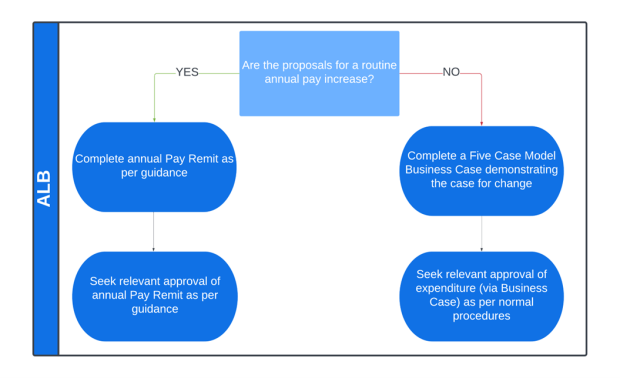
Annual Pay Remits are required to support routine annual pay increases for all staff groups within the scope of the guidance, in line with the relevant public sector pay parameters for the year under consideration. These should show clearly the pay proposals for each pay round and be submitted to the relevant approving authority. This applies even if the ALB follows the NICS pay award or a nationally determined pay settlement.
When staff working within the same ALB are subject to different pay agreements or pay determination processes, a separate annual Pay Remit must be submitted for each staff group. ALBs should normally only complete one pay remit per staff group per year.
If the proposals are for a routine annual pay increase, in line with public sector pay parameters then ALB’s should complete an annual Pay Remit and seek the relevant approval. Detailed guidance on completing the annual Pay Remit process can be found on the Annual Pay Remit Technical Guidance page.
If the proposals are not for a routine annual pay increase then it is likely that a pay-related Business Case may be appropriate.
When a pay-related Business Case is appropriate
Pay-related Business Cases are appropriate and required where a case for change is being made other than annual pay awards. This could include but is not limited to;
- changes to staff Terms & Conditions;
- changes to staff Grading structures;
- reforms to improve business performance and the efficiency of the workforce;
- payment to buy staff out of contractual entitlements.
In these circumstances, option appraisal (a key element of a Business Case) is integral to the assessment of value for money.
It is imperative that all departments adhere to the principles of public sector pay when considering the pay structures for newly established ALBs, when negotiating salaries or contracts of employment for new staff in existing ALBs or when initiating job evaluation exercises. ALBs will need to submit a robust, proportionate and fully costed business case, via their parent department, for their proposals that demonstrates clear value for money. Any ALBs considering this approach (including as to whether an annual Pay Remit or proportionate pay-related Business Case is required) should contact their parent department in the first instance, who should then liaise with DoF Supply.
Better Business Cases NI principles apply to pay-related Business Cases and the guidance for this can be found on the Better Business Cases NI page. Supplementary guidance on Pay-related Business Cases will be published in due course.
Remuneration of Chairpersons and Members of Public Bodies
The sections above relate specifically to the pay awards approval processes for public sector staff and the associated pay remit guidance. Separately, when considering remuneration/fees of chairpersons and members of public bodies, the following applies.
The practice of issuing annual “Dear Finance Director” letters on the above topic has been discontinued, with the last one published on 2nd July 2025 (Finance Director letters (FDs)).
This FD letter notes “the daily fees for Chairpersons and Members of Public Bodies and holders of broadly similar appointments are reviewed annually in accordance with wider public sector pay policy and may be increased with reference to the consolidated uplift to NICS pay-scales or pay-rates (usually a percentage) of the pay award for all non–industrial Civil Service staff, including SCS.” The detail of the relevant award relating to a particular year or period can be found at Civil Service pay and where a decision has been made to apply the increases in the Civil Service pay awards, the fee rates should be similarly uplifted. It is important to note that the fee rate increase should not include any progression element available to NICS employees, nor any non-consolidated payment that may or may not form part of the NICS pay award.
The increases should be subject to attendance and fully satisfactory performance and should apply to both full and part-time appointments. Some Chairpersons and members are paid a proportion of the daily rate, and departments should be aware of the basis for the calculation in cases where this is so.
Approvals
It will be for departments to find the necessary financial provision to cover the cost of pay or fee increases from within existing resources. ALBs and departments are responsible for ensuring that pay or fee increases are justified and receive approvals from the appropriate authority, and that any increases are in line with the approach to public sector pay. Any commitment to, or expenditure incurred, relating to such increases without the appropriate approvals will be deemed to be irregular expenditure.
Further information can be found within the technical guidance documents.
Contacts
Any queries relating to the annual Pay Remit approval process (including delegated authorities) should be addressed in the first instance to your parent department who can then contact the relevant Department of Finance (DoF) Supply Officer if required.
Queries on the technical aspects of the guidance should be addressed to payguidancequeries@finance-ni.gov.uk.